BRCA Testing Access During Breast Cancer Awareness Month — And Why Geography Still Determines Who Gets Early Detection
BRCA1/2 testing can change a woman’s cancer risk picture. Labs like Natera and Baylor Genetics run these panels. The barrier is often collection access.
What BRCA testing reveals — and why it matters
BRCA1 and BRCA2 are genes that, when functioning normally, help suppress tumor growth. When a variant is present in either gene, the risk of developing breast and ovarian cancer increases substantially — significantly higher than the general population's baseline risk in some cases.
Testing for BRCA1 and BRCA2 variants doesn't prevent cancer. But it creates the clinical basis for earlier and more frequent surveillance, access to risk-reducing interventions, and more informed treatment decisions for women who test positive. It gives patients and their physicians information that changes what they can do.
That information is accessible through a blood draw.
The labs running these panels
Labs like MOMS clients Natera, Baylor Genetics, and Fulgent Therapeutics can run BRCA1/2 panels with the clinical precision they require. Natera's hereditary cancer testing includes BRCA screening as part of comprehensive genetic risk assessment programs. Baylor Genetics' clinical laboratory has decades of experience in hereditary cancer genetics. Fulgent Therapeutics offers BRCA and expanded hereditary cancer panels with high-sensitivity sequencing.
The collection requirement for any of these panels is straightforward: a blood draw from a qualified, trained collector who handles the specimen correctly and documents the chain of custody completely.
The collection access gap
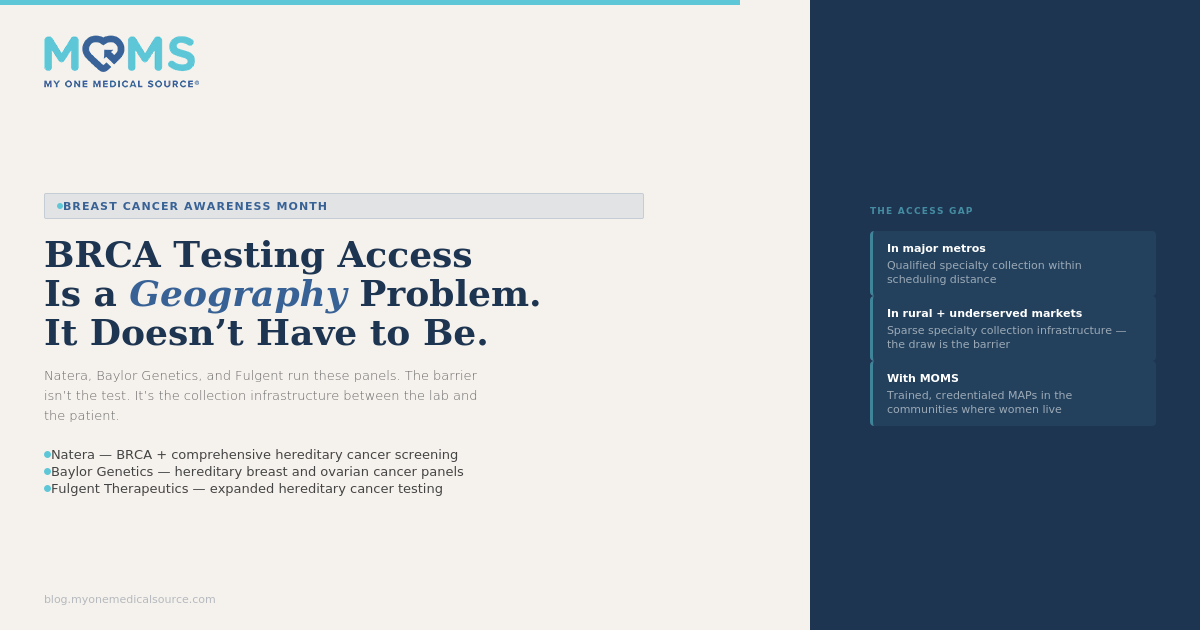
For women in major metropolitan areas near research hospitals and large healthcare systems, completing a BRCA blood draw is a scheduling question. A qualified draw site exists within a reasonable distance. The collection is routine.
For women in rural communities, smaller cities, and underserved neighborhoods, the picture is different. Specialty collection infrastructure — the credentialed, trained collectors who can handle a genetic testing panel and meet the laboratory's documentation standards — is not consistently available outside major metro areas.
The barrier isn't awareness of the test. It isn't willingness to pursue it. It's a logistics gap: no qualified draw site within a practical distance, no infrastructure to close that gap, and a healthcare system that has been slow to recognize that access to the collection is as much a part of access to the test as access to the order.
What closing that gap requires
A national collection network with geographic depth in rural counties, smaller MSAs, and underserved communities. Collectors who are trained specifically on genetic testing collection protocols — not just general phlebotomy — before their first draw. Chain of custody documentation that meets the lab's standard from the draw site, not just from the processing point.
MOMS builds this infrastructure. The MOMS MAP: Medical Access Point/Provider™ network covers all 50 states, including the markets where hereditary cancer risk is no less common and specialty collection infrastructure has historically been absent. MAPs connected to labs like Natera, Baylor Genetics, and Fulgent Therapeutics complete Sticklogistics® training on the specific collection protocol for each lab's panels before their first draw.
This Breast Cancer Awareness Month
BRCA testing access is a health equity issue. The women who are most likely to face barriers to completing a BRCA blood draw are often the same women who face broader healthcare access barriers — women in rural communities, low-income women, women in communities that have historically been underserved by the healthcare system.
The science is there. The test is there. The labs running it are there. The collection infrastructure that makes it accessible in every community where women live is what MOMS builds.
Access to early detection is access to a different outcome. The collection is where that access starts.