Three months of content about the collection gap in specialty diagnostics.
The 30% incompletion rate. The geographic dead zones. The compliance burden of building your own network. The ordering physician relationships that erode when draws don't complete. The patients in rural communities who can't finish tests their physicians ordered because there's nowhere nearby to collect the blood.
Today we're being direct about what MOMS actually does about all of it — how the platform works, what labs get. when they connect, and what the process looks like from first conversation to active collection coverage.
What MOMS is
My One Medical Source® (MOMS) is a specialty diagnostic lab specimen collection platform. Our tagline is The Connection for the Collection™, and that's a precise description of the function: MOMS is the connection layer between specialty labs and diagnostic clients, and the national network of MAPs: Medical Access Points/Providers™ who complete their draws.
MOMS is not a staffing agency. It's not a general-purpose phlebotomy network. It was built specifically for the specialty diagnostic testing market — for the labs running molecular panels, genetic screens, oncology biomarkers, rare disease tests, and other test categories that require more from a collection partner than a standard draw site provides.
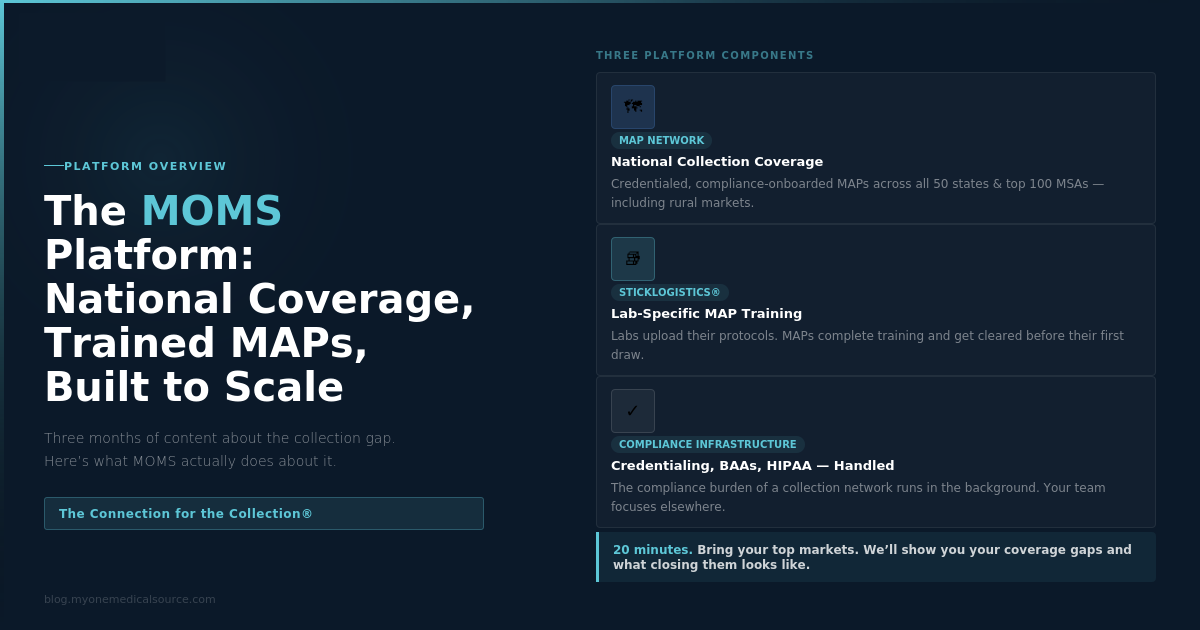
The platform has three core components that work together to deliver what specialty labs need from a collection infrastructure:
The MAP network
MAPs: Medical Access Points/Providers™ are credentialed, compliance-onboarded collection professionals — phlebotomists, draw sites, and mobile collection providers — who are active in the MOMS platform across all 50 states and the top 100 metropolitan statistical areas.
Every MAP in the network has completed the MOMS compliance onboarding process before their first draw: credential verification, HIPAA coverage and Business Associate Agreement execution, chain of custody protocol training, and deviation reporting procedures. The standard isn't general phlebotomy competency. It's verified, documented readiness to operate as a specialty collection partner.
The network includes geographic coverage in rural and semi-rural markets that most national draw networks don't reliable serve — which is where specialty lab patients most often encounter barriers. It is the only solution offering both brick-and-mortar and mobile phlebotomy options.
The MOMS MAP network covers all 50 states (including DC and Puerto Rico) and the top 100 MSAs — including rural and semi-rural markets where specialty infrastructure has historically been absent. It includes both brick-and-mortar and mobile phlebotomy options.
Sticklogistics®
Sticklogistics® is MOMS' proprietary MAP onboarding and training platform — a learning management system built specifically to ensure that every MAP connected to a lab delivers collections that meet that client's exact specifications.
Here's how it works: when a specialty lab connects to MOMS, they upload their test-specific training materials to Sticklogistics® — kit handling instructions, tube requirements, draw order protocols, chain of custody documentation standards, deviation reporting procedures, and any other collection specifications their test requires. This information serves as a proficiency module and can include PDFs, videos, walkthroughs, and quizzes. Connected MAPs access and complete that training within the MOMS MAP Portal before they're cleared to collect for that lab.
When protocols change — a new test added, an updated kit configuration, a revised chain of custody requirement — the lab updates their Sticklogistics® modules and MAPs complete the updated training before collecting under the new protocol.
The result: every MAP collecting for your lab has been trained on your protocols, not general phlebotomy best practices. The collection that happens in the field reflects the collection standard your test requires.
Compliance infrastructure
The compliance burden of managing a specialty collection network — credentialing, HIPAA coverage, Business Associate Agreement execution, state licensure monitoring, re-verification — sits with MOMS, not the lab.
Every MAP's credentials are verified before onboarding. BAAs are executed at the platform level. License renewals and re-certification requirements are monitored. When a compliance gap emerges, MOMS addresses it before it becomes the lab's problem.
For a specialty lab that would otherwise be building and maintaining this compliance infrastructure across dozens of draw site partners, the MOMS platform eliminates an entire operational function.
What labs get when they connect
When a specialty lab connects to the MOMS platform, the practical change is immediate:
-
Geographic collection coverage in markets the lab couldn't reliably serve before — including rural markets, smaller MSAs, and geographies where the lab's existing draw site relationships have gaps.
-
MAPs who are credentialed, compliance-onboarded, and trained on the lab's specific collection protocols before their first draw.
- A compliance infrastructure that covers HIPAA, BAAs, credentialing, and licensure monitoring — running in the background without requiring lab staff time to maintain.
- Sticklogistics® access to build and deliver test-specific training to MAP connections, with documentation training completion before collection clearance.
- The coverage assessment that shows the lab, specifically, where their collection gaps are against their actual ordering markets — and what closing those gaps look like.
The timeline from coverage assessment to active MAP connections varies by market and test category but is typically measured in weeks rather than months — because the network infrastructure already exists. Labs aren't building draw site relationships from scratch. They're connecting to a network that has already done that work.
Who MOMS is for
The MOMS platform is the right fit for specialty labs that meet a few specific criteria:
-
Patient populations that are geographically distributed — labs whose ordering physician relationships span multiple states, regions, or geographies beyond their home market.
-
Multiple test categories with different collection requirements — labs running more than one specialty test type that would require maintaining and compliance infrastructure across different protocols if building direct draw site relationships.
-
Growth-stage commercial plans — labs planning new test launches, geographic expansions, or new client relationships that require collection coverage in markets not currently served.
-
Infrastructure-limited operations — labs whose team doesn't have the bandwidth to build, train, and maintain a direct collection network alongside their core clinical and commercial functions.
If any of those descriptions fit, the MOMS platform was built for your lab.
The Connection for the Collection®
The collection gap in specialty diagnostics is real, it's large, and it's costing the labs it affects in revenue, physician relationships, and commercial reach.
It's also solvable — and the infrastructure to solve it exists. National geographic coverage, trained and credentialed MAPs, Sticklogistics® protocol training, and a compliance layer that runs without requiring a dedicated lab operations function.
MOMS is The Connection for the Collection®. For the labs that have connected, that connection has changed the revenue trajectory, the physician retention rate, and the competitive position of their business.
The coverage assessment is the starting point. It takes 20 minutes and produces a specific, honest picture of your collection coverage and what better looks like.