The Test Categories Driving Q4 Specialty Lab Volume — And the Collection Infrastructure Behind Them
From GRAIL to Natera to Guardant and NeoGenomics — Q4 specialty lab volume is driven by tests that make specific demands of collection infrastructure.
Q4 is the highest-volume quarter in specialty diagnostics
Year-end benefit utilization, Q4 physician ordering patterns, and the clinical momentum that builds through the second half of the year combine to make October through December the highest-volume ordering quarter for specialty diagnostic labs.
The tests driving that volume are not generic. They are among the most clinically significant technically demanding in specialty medicine — tests that make specific requirements of the collection infrastructure that handles them.
Labs that go into Q4 with collection infrastructure built for their specific protocols are running a different quarter than the ones whose MAP network is operating on general phlebotomy training.
The tests leading Q4 volume
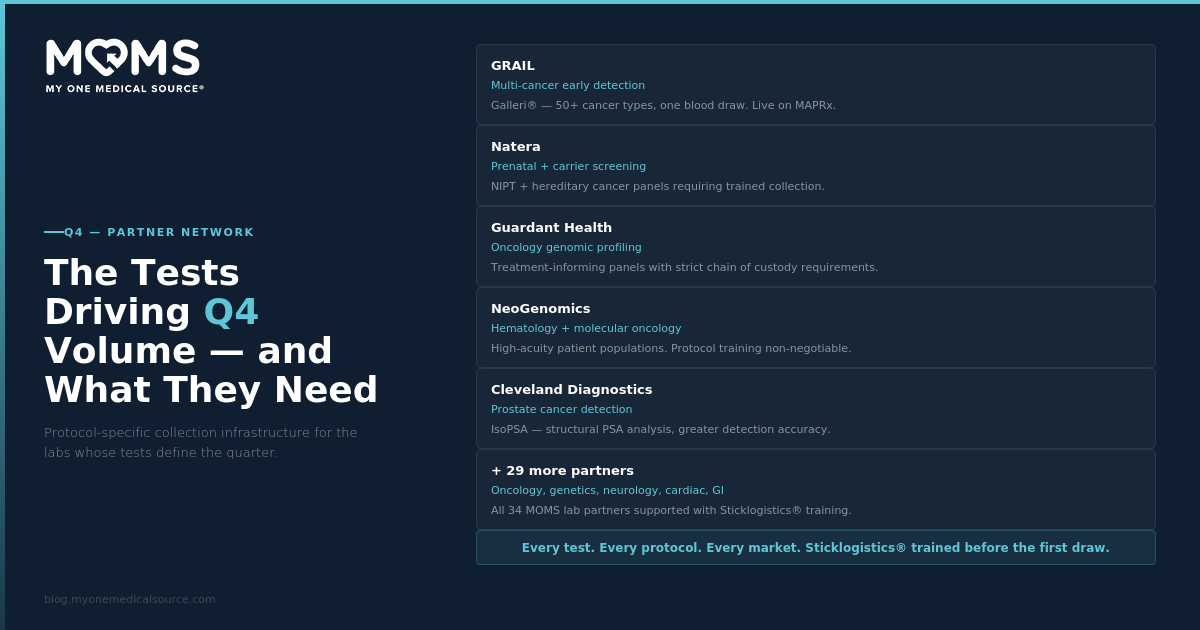
GRAIL's Galleri® multi-cancer early detection assay screens for signals associated with more than 50 cancer types from a single blood draw. As multi-cancer early detection moves from clinical study context into broader clinical adoption, Q4 ordering volume reflects growing physician and patient awareness of what early detection means for outocmes.
Natera's prenatal and carrier screening panels — including NIPT and comprehensive carrier screens — see sustained Q4 volume driven by year-end benefit timing and the clinical cycles of reproductive health management. These panels require trained collection and specific specimen handling.
Guardant Health's oncology testing provides oncologists with genomic profiling data that informs treatment selection. The clinical stakes of these panels — and the specific collection requirements that ensure specimen quality — make trained collection non-negotiable.
NeoGenomics' hematology, pathology, and molecular oncology testing serves some of the highest-acuity patient populations in specialty medicine. Q4 volume includes both routine monitoring draws and clinically urgent specimens that require collectors who understand the protocol.
Cleveland Diagnostics' IsoPSA test measures the structural properties of PSA in the blood to distinguish aggressive from non-aggressive prostate cancer with greater accuracy than the standard PSA test. For urologists using IsoPSA to guide biopsy decisions, the collection quality determines the result quality.
What protocol-specific collection actually requires
The labs above don't have identical collection requirements. Galleri® has specific tube and timing specifications. Natera's carrier screens have particular specimen handling requirements. Guardant's oncology panels have chain of custody documentation standards tied to clinical oncology workflows. NeoGenomics' hematology testing involves specimen types and handling requirements specific to hematological analysis. IsoPSA has collection specifications that differ from a standard PSA draw.
A MAP who has completed Sticklogistics® training on a specific lab's protocol knows these requirements before the first draw. They don't look them up at a collection site, although it is readily available on the MOMS platform. They don't make assumptions based on their general phlebotomy experience. They execute the protocol the lab requires, document it correctly, and ship the specimen with confidence that it will arrive ready to produce a valid result. That's the difference between a collection network and a trained collection network.
The labs running Q4 on MOMS infrastructure
MOMS lab and diagnostic client partners include labs across oncology, genetic testing, neurology, cardiac, GI, infectious disease, women's health, rare disease, and functional medicine. The collection infrastructure MOMS provides — national MAP coverage, Sticklogistics® protocol training, credentialing, and compliance — is the same for a new test launch in Q4 as it is for an established panel with years of collection history on the platform.
Q4 is the quarter where the gap between general collection capacity and protocol-specific collection expertise is most viable. The orders are there. The specimens are moving. The labs that built their collection infrastructure for their specific protocols are running Q4 the way they planned it.