Specialty diagnostic testing increasingly depends on kit-based collection — pre-assembled tube sets, test-specific handling instructions, and chain of custody requirements built around the exact needs of a single assay.
The science behind these tests is often sophisticated. The collection requirements that protect that science are exacting in a way most general-purpose draw networks were never built for.
And the gap between what a specialty test can detect and what the lab actually receives depends almost entirely on what happens at the draw site — before the specimen ever reaches the instruments, the reagents, or the analysis pipeline that makes the science work.
Why kit-based collection is different from standard phlebotomy
Standard venipuncture is a highly refined skill. A trained phlebotomist who performs a clean draw, fills the correct tubes in the correct oder, and labels them accurately at the chair is doing the job correctly — for routine testing.
Kit-based specialty collection requires all of that plus a layer of test-specific knowledge that standard phlebotomy training does not cover. The collector who performs a specialty draw without reviewing a specific kit's instructions isn't necessarily doing anything wrong by the standards they were trained to. They may be performing a collection that produces an invalid specimen without knowing it.
This is the risk specialty labs consistently underestimate: not that draw sites are incompetent, but that they're applying competent standard practice to a context that requires something different, test by test.
The pre-analytical variables that determine result validity
Tube type and matching
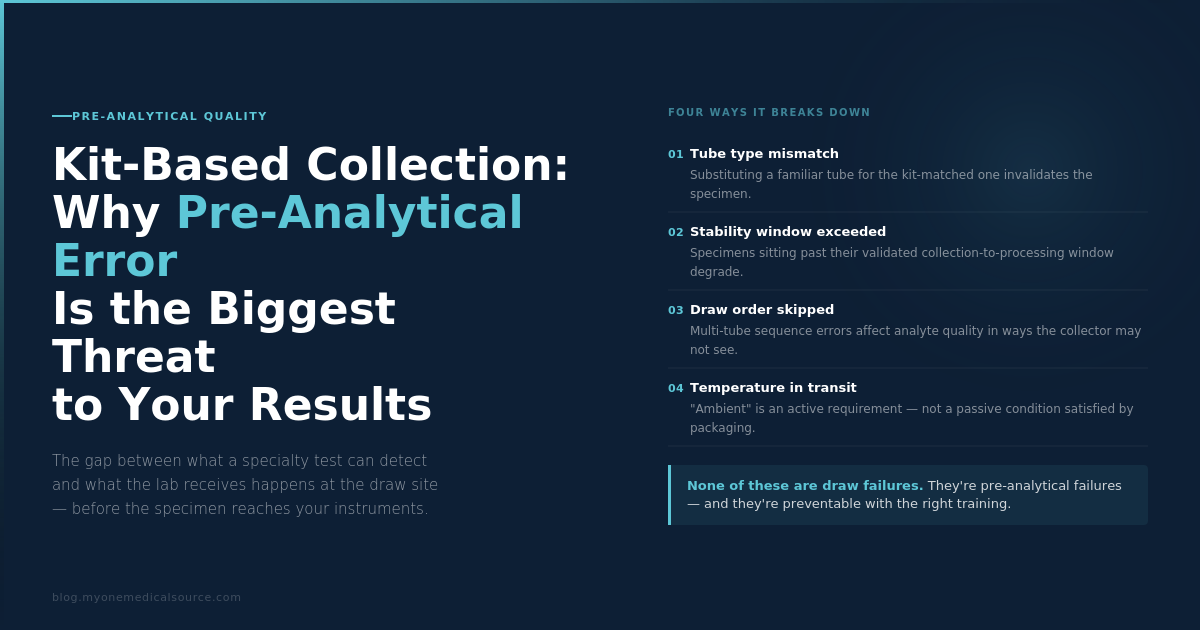
Specialty kits frequently arrive with a tube configuration matched precisely to that test — not the standard tubes a draw site keeps on hand for routine panels. The difference between a kit-matched tube and a visually similar standard tube can be significant: different additives, different draw volumes, different stabilization chemistry.
A collector who substitutes a familiar tube because the kit tube looks close enough has not completed the collection correctly — even when every other step of the draw was technically clean.
A specialty collection drawn into the wrong tube isn't a suboptimal specimen. In many cases, it's an invalid one — because the assay was validated for a specific tube chemistry the substitute doesn't provide.
Time from collection to processing
Many specialty tests have a defined window between collection and processing during which specimen integrity is assured. Outside that window, analyte degradation, cellular breakdown, or chemical instability can compromise the result — even when the tube and draw technique were correct.
A specimen collected on a Friday afternoon and sitting in a draw site's shipping queue through the weekend has frequently exceeded the validation stability window for the assay, regardless of how t he draw itself was performed.
Labs deploying specialty tests at scale need draw site partners who understand the collection-to-processing timeline is a quality variable — not a logistics afterthought.
Draw order and handling steps
For multi-tube specialty collections, the sequence in which tubes are filled can affect specimen quality. Additional handling steps — inversion counts, settling time, immediate versus delayed processing — are often kit-specific and easy to miss when a collector is moving quickly through a busy schedule.
None of this is standard phlebotomy knowledge. It's protocol that has to be reviewed and followed for that specific kit, every time — not assumed from prior experience with a different test.
Temperature in transit
Many specialty specimens ship within a defined temperature range — not always refrigerated, not always frozen, but within specific bounds that vary by test. That range is an active quality requirement, not a passive condition satisfied by standard packaging.
A specimen shipped from a draw site on a hot afternoon, sitting on a loading dock for several hours before carrier pickup, may well have exceeded the assay's temperature tolerance. The shipping label says the kit was used correctly. The specimen's actual thermal history may say otherwise.
What happens when pre-analytical requirements aren't met
The outcomes aren't subtle.
An assay validated for one tube chemistry, run on a specimen collected in a substitute tube, may produce results the lab can technically report but that aren't clinically reliable — or that fail quality thresholds and can't be reported at all.
A specimen that exceeded its stability window before processing may fail to meet the assay's input requirements entirely. The result is a test failure — which generates a re-draw request, a patient who may or may not attempt a second collection, and a delayed clinical decision.
A chain of custody documentation gap — incomplete temperature recording, missing collection time, undocumented deviation from kit instructions — may trigger a payer audit that results in a retroactive denial for a result that was otherwise clinically valid.
None of these outcomes are the lab's failure at the analytical stage. All of them trace back to the draw site.
Building the collection infrastructure for kit-based specialty testing
The labs commercializing specialty tests successfully — the ones with reliable completion rates and low re-draw rates — have solved the pre-analytical problem before deploying into a market, not after the first round of invalid specimens.
That means establishing draw site partnerships with collectors who review and follow kit-specific instructions as standard practice — not collectors who default to familiar procedures when something looks close enough.
It means kit design that makes correct collection the path of least resistance: pre-assembled tube sets, printed protocol summaries inside the kit, and clear handling instructions that don't require the collector to interpret ambiguous steps under time pressure.
And it means collection network infrastructure with the geographic reach to put trained, qualified collectors in the markets where specialty orders originate — including the rural and semi-rural markets outside major metros where ordering physicians practice and where patients live.
MAPs: Medical Access Points/Providers™ on the MOMS platform are trained on test-specific collection requirements before their first draw on any new kit — not generic phlebotomy refresher content, but the specific protocol knowledge the draw site needs to complete the specific test the lab is deploying.
The science behind specialty testing is often sophisticated. Protecting it starts at the draw site.
Sources
- Clinical and Laboratory Standards Institute. Procedures for the Collection of Diagnostic Blood Specimens by Venipuncture. CLSI GP41.
- College of American Pathologists. Pre-Analytical Variables in Laboratory Testing: A Review. CAP Today.
- Lippi G, et al. Preanalytical quality improvement: from dream to reality. Clin Chem Lab Med. 2011;49(7):1113-26.
- World Health Organization. WHO Guidelines on Drawing Blood: Best Practices in Phlebotomy. 2010.