Qualified phlebotomists are becoming harder to find, harder to retain, and increasingly concentrated in urban and suburban markets. The workforce that specialty labs depend on to complete draws in the communities their patients actually live in is a challenge for labs of all sizes.
For reference labs processing high volumes of routine tests in major metro markets, the phlebotomy workforce shortage is a manageable headwind. For specialty labs that need qualified collectors with specific training in smaller markets, semi-rural regions, and non-hospital outpatient settings, it is becoming a ceiling on growth.
What the workforce data actually shows
The Bureau of Labor Statistics projects phlebotomy as a growth occupation nationally. The 10-year outlook shows steady demand growth driven by an aging population, the expansion of outpatient diagnostic services, and the proliferation of specialty testing categories that didn't exist a decade ago.
That top-line projection obscures a geographic reality that specialty labs deal with every day.
Phlebotomy training programs, certification pipelines, and employer relationships are concentrated in metropolitan areas. Hospital systems and large reference labs, which offer benefits, stable scheduling, and institutional credibility, absorb a disproportionate share of new phlebotomists entering the workforce. Independent draw sites and smaller outpatient settings in non-metro markets compete for what's left.
Phlebotomy demand is growing nationally. But in the rural and semi-rural markets where specialty lab patients often live, the qualified workforce is thinning.
The result is a workforce distribution problem layered on top of a workforce availability problem. There may be enough phlebotomists nationally to meet demand. There are not enough qualified, available specialty-trained collectors in markets where specialty labs need them.
Why the shortage hits specialty labs harder
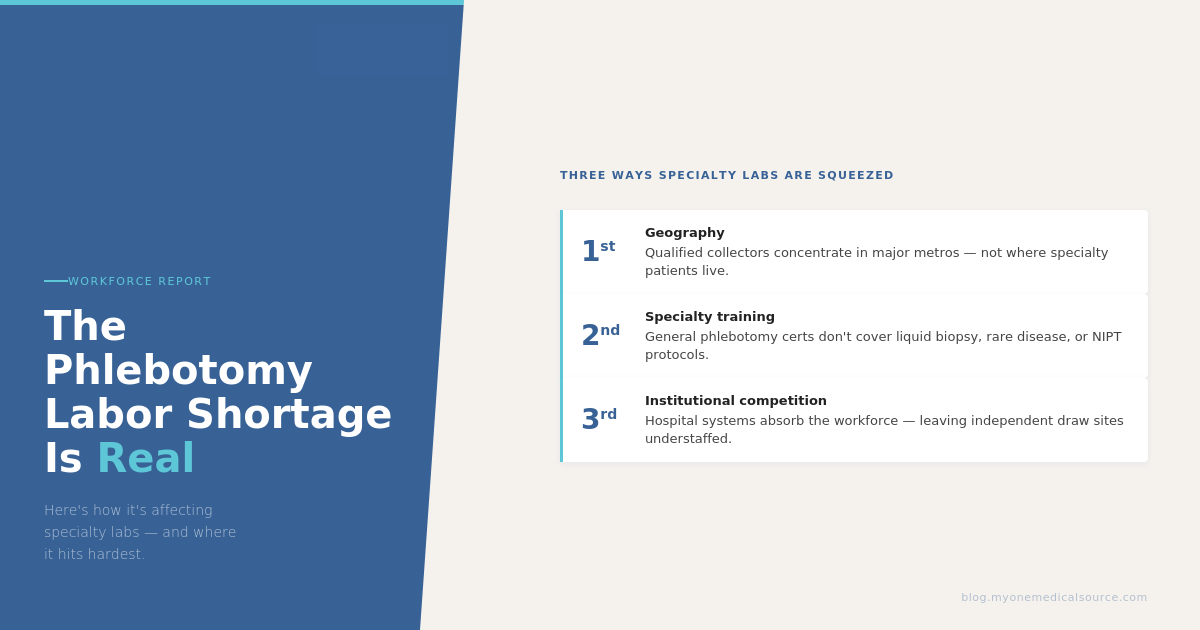
The phlebotomy labor shortage doesn't affect all labs equally. Independent, specialty labs face three compounding disadvantages that reference labs largely don't.
Geography
Specialty lab patient populations don't concentrate in major metros. Rare disease patients, hereditary cancer screening cases, post-discharge monitoring patients, prenatal genetics patients, etc. are geographically distributed across the full range of where people live, including rural counties, small cities, and suburban markets outside the major metropolitan centers where phlebotomy labor is most available.
A specialty lab serving patients nationally needs qualified collectors in markets where the phlebotomy workforce is thinnest. That's where the shortages bite the hardest.
Specialty training requirements
A standard phlebotomy certification covers venipuncture technique and basic clinical procedures. It does not cover specialty kit handling protocols, liquid biopsy collection requirements, temperature-sensitive specimen management, draw order for specialty panels, or the chain of custody documentation that specialty labs require.
The pool of collectors who can complete a specialty draw correctly is smaller than the general phlebotomy workforce and it shrinks further in markets outside major metros.
When a specialty lab needs a collector in a rural market, they're not just competing for any phlebotomist. They're competing for one with the right training, the right availability, and the right willingness to take on kit-based specialty collection work.
Institutional employment competition
Hospital systems and large reference labs employ phlebotomists directly. They offer benefits, predictable scheduling, institutional training programs, and career progression that independent draw sites and specialty lab network partners typically cannot match.
This creates a structural disadvantage for the independent, specialty-focused collection infrastructure that specialty labs depend on. The collectors who might otherwise operate as independent draw site partners in underserved markets are being absorbed by institutional employers in the markets where they do exist.
What this means for specialty lab operations
The phlebotomy labor shortage manifests in specialty lab operations in several specific ways that are worth naming directly.
Draw coverage gaps appear in markets that were previously reliable. A draw site partners loses their only qualified phlebotomist. Coverage in that market goes dark. The lab scrambles to find a replacement relationship, often taking weeks, during which patient orders in that market pile up or go elsewhere.
New test launches face collection infrastructure constraints before they face clinical or commercial ones. A lab commercializing a new specialty test may have strong ordering physician relationships and a clear patient population and then discover that the collection infrastructure needed to serve that patient population doesn't exist in key markets.
Rural and underserved market access degrades over time. As qualified collectors leave smaller markets for urban institutional employment, the pockets of specialty collection availability in rural areas gets smaller. Labs that had marginal rural coverage find it disappearing.
The labs navigating this best aren't solving it by hiring
The specialty labs that have the most stable collection infrastructure despite the labor shortage share a common approach: they're not trying to solve a market-level problem with individual hiring decisions.
They're solving it by connecting to networks that have already done the work of building collector relationships across geographies, maintaining specialty training requirements, and covering the markets where direct hiring isn't economically viable.
That's the model MOMS was built around. Rather than asking specialty labs to build and maintain collection relationships market by market (a full-time infrastructure job that most labs shouldn't be doing) MOMS provides access to a national MAP: Medical Access Point/Provider™ network with pre-vetted, specialty-trained collectors across all 50 states.
When the phlebotomy market in a specific region tightens, the network absorbs the impact rather than passing it to the lab as an unexpected coverage gap.
The bottom line
The phlebotomy labor shortage is a real, documented phenomenon with specific implications for specialty labs. It's not uniform - it hits hardest in the markets where specialty labs most need collection coverage - and it's getting worse, not better, as institutional employers continue to absorb the most accessible parts of the workforce.
The labs building collection infrastructure that holds up under these conditions aren't building it through individual draw site relationships in each market. They're building it through networks with geographic depth, specialty training requirements, and the scale to maintain coverage when local labor market conditions shift.
That infrastructure exists. And for specialty labs trying to grow in a market where collection coverage is a real constraint on how far their tests can reach, it's worth understanding what it looks like.