Every uncollected specimen is revenue that was ordered and never realized. Most specialty labs know this is happening. Almost none of them know how much it is costing, or exactly where it's breaking down.
The gap between a lab order and a completed draw is the single most under examined source of revenue leakage in specialty diagnostics. It doesn't show up neatly on a P&L. It doesn't trigger an alert in the LIS. It just disappears quietly, order by order, market by market, until the cumulative cost becomes large enough to notice.
By then, it's been happening for a long time.
The number most labs aren't tracking
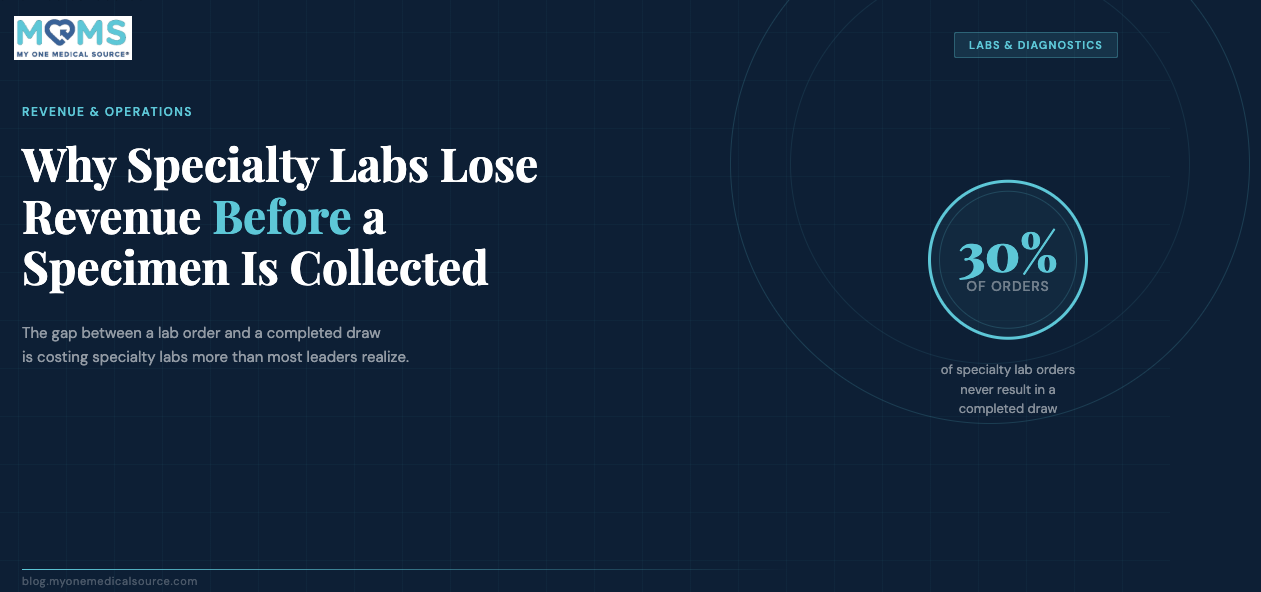
Industry data consistently places the average lab order non-completion rate around 30%. That means roughly one in three tests that a physician orders, with clinical intent for a specific patient, never results in a specimen reaching the lab.
30% of specialty lab orders never result in a completed draw. That's not a rounding error. It's a structural failure.
The 30% figure is an industry average. For specialty labs, particularly those operating outside major metropolitan markets or those running test categories that require specific collector training, the real number is often higher.
And because most labs track what comes in rather than what was ordered and never arrived, the gap stays invisible. You see the revenue you generated. You don't see the revenue you lost before the specimen ever left the draw site.
Where the revenue actually disappears
Not all collection failures look the same. In our experience working with specialty labs across the country, revenue leakage from incomplete draws concentrates in three specific places.
-
Geographic dead zones
This is the most common and most costly failure mode for specialty labs. The ordering physician is in a major metro. The patient lives 40 miles from the nearest qualified draw site, or in a county where no draw site in the lab's network operates.
The order exists. The clinical need exists. The infrastructure to complete the draw does not.
Most specialty labs have well-developed collection relationships in their home market and in the major metropolitan areas where their client relationships are strongest. Outside those geographies, coverage thins quickly. When a patient falls outside the coverage footprint, the order doesn't fail dramatically, it just quietly never gets completed.
The labs that have mapped their order-to-completion rate by geography, rather than in aggregate, consistently find that their worst-performing markets look nothing like their best-performing ones. Completion rates that look reasonable at the lab level often mask 20-30 percentage point swings across geographies.
- Patient no-shows that are actually infrastructure failures
When a patient doesn't show for a draw, it typically gets logged as patient non-compliance. The order sits. Sometimes a follow-up is attempted. Often it isn't.
But the root cause of most draw appointment failures isn't patient behavior. It's a combination of scheduling friction, insufficient instruction, and the simple reality that asking a patient, often one managing a significant health situation, to travel to a draw site they've never been to, for a procedure they may not fully understand, is a higher bar than it appears.
When the draw site is inconvenient, when the scheduling process is complicated, when the patient didn't receive clear instructions about what to bring or how to prepare, no-show rates climb. The problem is the infrastructure. Logging it as patient non-compliance means the infrastructure never gets fixed, and the revenue keeps disappearing.
- Draw site mismatches
Not every draw site is equipped to complete every specialty test. Tube type requirements, temperature handling, draw order protocols, chain of custody documentation - these vary significantly across specialty test categories, and a general-purpose draw site that handles routine bloodwork reliably may not be equipped for a liquid biopsy panel or a rare disease genetic specimen.
When a collection is attempted by a draw site that isn't trained or equipped for the specific test requirements, two things happen: the specimen may be collected incorrectly and rejected on arrival, or the draw site may not be equipped for a liquid biopsy or a rare disease genetic specimen.
Both outcomes produce the same result: an incomplete draw and a lost revenue event. The difference is that the second scenario may not even generate a record that anything was attempted.
What the cost actually looks like
For a cost breakdown, we will use a mid-size specialty lab processing 2,000 orders per month.
At a 30% incompletion rate, 600 draws per month are ordered and never completed. At an average specimen collection value of $150, that's $90,000 per month and $1.08 million annually in revenue earned on paper that never captured.
A 10% improvement in collection completion doesn't require a commercial restructuring. It requires closing 60 additional draws per month in markets where the infrastructure currently falls short.
That is $108,000 per year in recovered revenue from orders the lab already has.
A 10% improvement in draw completion on 2,000 monthly orders at $150 average value = $108,000 in annual recovered revenue.
For labs processing higher volumes, or running tests with higher pre-draw reimbursement, the math scales accordingly. The revenue at stake is significant, and it's already yours.
The bottom line
Revenue that disappears before a specimen is collected is the hardest kind of revenue leakage to see because it never generates a transaction record. There's no failed charge, no rejected claim, no returned specimen. There's just an order that was placed and a result that was never delivered.
The labs that are closing their collection gaps aren't doing it by working harder on the orders they already receive. They're doing it by making sure the orders they already have actually get completed in every market, for every test, for every patient.
The infrastructure to do just that exists with MOMS. The revenue waiting on the other side of it is real.